LeadFlow
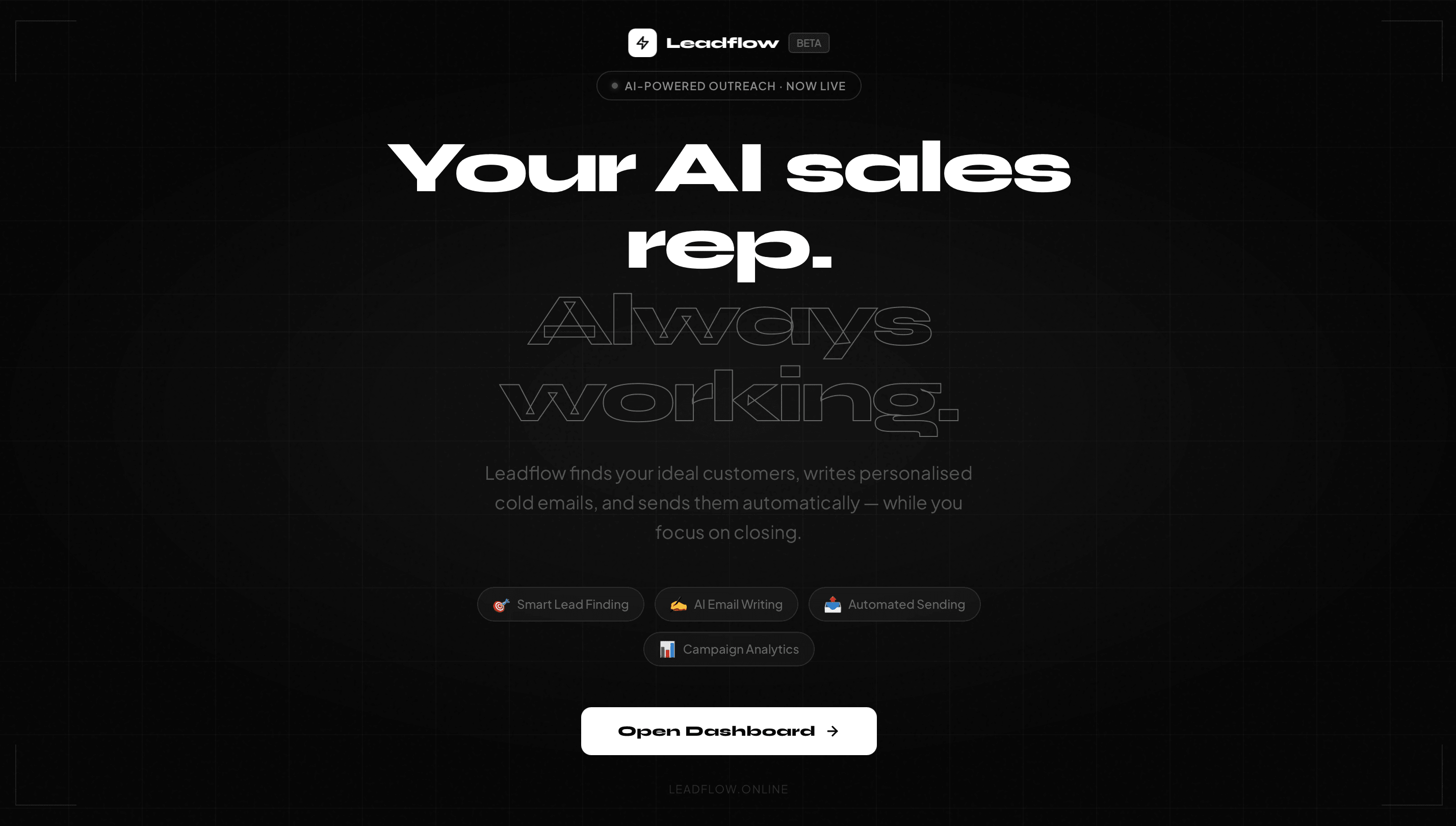
A full stack AI outreach agent that finds ideal customers, writes a personalised cold email for each one, and sends it from your own Gmail, with a human review queue kept deliberately in the loop. I built it to run my own job search.
Outcome
5-10
Qualified leads per run
In the product
Context
Cold outreach tools either cost hundreds a month or send the same generic message to everyone, and writing personalised emails by hand does not scale. Most tools that claim full automation also remove the human judgement that makes outreach actually land. LeadFlow was built to solve all three at once, and became the tool I used in my own job search.
Approach
- 01You describe the target customer: your business, what you offer, the job title to reach, and a location.
- 02LeadFlow finds real people at real companies through the Hunter.io and Apollo APIs, then scrapes each company website for context.
- 03GPT-4o, orchestrated with LangChain, writes a unique sub 80 word email per prospect in a direct human tone, grounded in the scraped company context.
- 04Every draft lands in a review queue. You read, edit, approve, or delete before anything sends. Approved emails go out natively through the Gmail API, with automatic follow ups at day 3 and day 6.
How it works
Input
Define the target
Business, offer, role, and location
Discovery
Hunter.io + Apollo
Real people, verified emails, company sites
Context
Website scraping
Gathers what each company actually does
Generation
GPT-4o + LangChain
A unique sub 80 word email per prospect
Human in loop
Review queue
Edit, approve, or delete before anything sends
Delivery
Gmail API
Native send, auto follow ups on day 3 and 6
Results
5-10
Qualified leads per run
1-2s
To generate each personalised email
Human in loop
Review queue before any send
Reflection
The review queue is the whole point, not an afterthought. Full automation sounds powerful until one bad email reaches the wrong person, so LeadFlow removes the repetitive research and drafting while keeping a human in control of what actually sends. The hardest problem turned out to be the writing itself: GPT-4o's default output reads like GPT-4o, generic, over-polished, missing the specific detail that makes an email feel like it was actually written by a person who looked at your company. Prompting it toward a grounded, sub-80-word, human tone got it closer, but getting cold email copy that consistently doesn't sound AI-generated is still the open problem I'd keep working on.